Fresh looting pits vs old plow scars: what to look for in VHR imagery
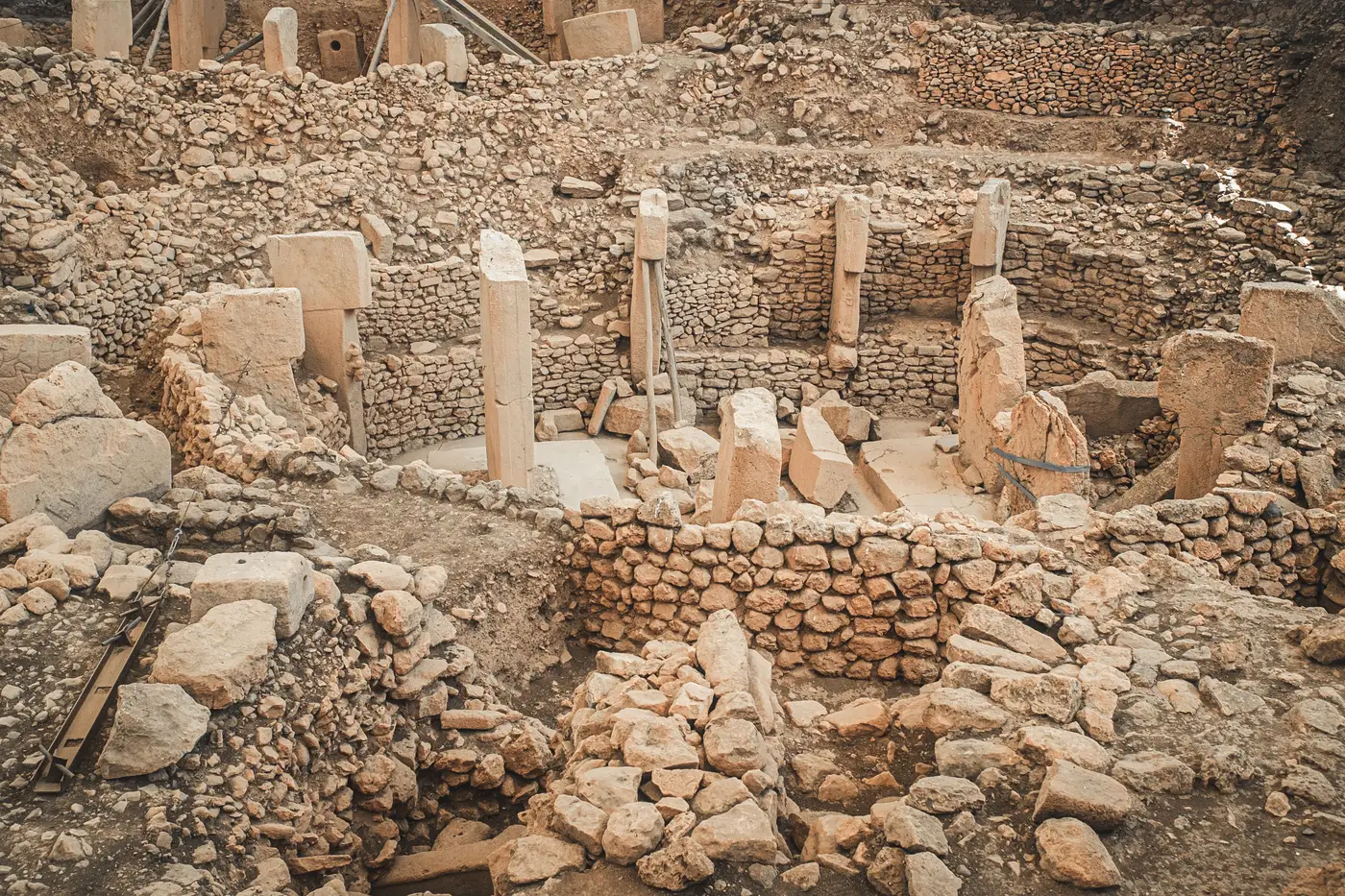
Anyone who has spent an afternoon scrolling through archived frames of a tell or a necropolis has hit this problem: a cluster of dark, round marks that could be looting pits, or could just be last season's plowing catching the light wrong. At 0.5 m or better the two start to separate, but only if you know what to check and in what order.
Shape first, then shadow
Plow scars run in long, parallel, straight-edged lines that follow the field boundary or the direction the tractor was pulling an implement. They rarely cluster. A looting pit, by contrast, shows up as a roughly circular or oval depression, often in a tight group near a mound, wall line, or known burial field, and the spacing between pits is irregular because the diggers are following what they think is underneath, not a row pattern.
Shadow geometry is the next check, and it does more to separate "disturbance" from "no disturbance" than it does to pin down age on its own. A looting pit has a steep wall on at least one side, which throws a hard, short shadow even at a relatively high sun angle. A plow furrow is shallow and wide, so its shadow is faint and only shows up at all near dawn or dusk pass times when the sun azimuth is low. If you're working with a midday acquisition and you still see a crisp shadow edge, that favors a pit over a furrow regardless of shape.
Spoil color and the freshness clock
This is where dating happens, more or less. A freshly dug pit throws spoil (the excavated backfill) onto the surface next to the hole, and that material has not weathered yet. It shows up lighter or darker than the surrounding soil depending on substrate, with sharp, high-contrast edges and no vegetation growing through it. Over a few months the spoil edge softens, dust and wind-blown sediment start to even out the tone, and grass or scrub begins to colonize the disturbed soil from the margins inward. By a year or more, the spoil heap can be almost indistinguishable from background soil color and the only clue left is the depression itself and maybe a faint ring of altered vegetation.
A plow scar, meanwhile, doesn't produce a spoil heap at all. The disturbed soil is turned in place, not piled, so you get a uniform tone across the furrow rather than a bright patch next to a dark hole. If you're seeing paired tones (a hole plus an adjacent bright or dark mound), you're looking at excavation, not cultivation.
Vegetation recovery rate is your rough timestamp. Bare, high-contrast spoil with sharp edges points to disturbance inside the last review cycle. Spoil with partial green-up and softened edges points to something that happened one or two quarters back. Full vegetation cover over a filled depression, with only the ground's surface contour giving it away, is old, often many seasons old, and probably not what a monitoring report needs to flag as new.
Where this breaks down
None of this is foolproof from a single frame. Recent ground disturbance from construction, erosion gullies after heavy rain, and animal burrows can all throw a similar shadow-and-spoil signature, and a single image rarely gives you enough to rule those out. What actually separates a looting pit from everything else is change over time at the same coordinates: a feature that wasn't there last quarter and is there now, with the fresh-spoil signature described above, is a much stronger call than any one frame read in isolation.
That's the part that eats an officer's week when it's done by hand, since it means pulling the prior quarter's frame for every monitored site and eyeballing it side by side with the current one, tell by tell. Looting Monitoring runs that comparison for you and returns a dated before/after pair with the new disturbance flagged, so the shadow-and-spoil read above is confirming a flagged change rather than hunting for one across a raw image dump.
If quarter-to-quarter comparison across your monitored sites is eating more review time than it should, it's worth seeing what Looting Monitoring flags on your next cycle.